The filtering system and the cleaning performance of robot pool cleaners are the two most important factors to consider. You're investing your money into this essential characteristic: the robot's capacity to keep your pool clean by actively eliminating contaminants. Understanding the different ways robots accomplish this will aid you in selecting the one most suitable for the specific issues with debris and guarantee you stunning results.
1. The cleaning Trinity The cleaning Trinity: suction, scrubbing and filtration.
You must understand that effective cleaning involves three parts. First, brushes must agitate and loosen debris from the surface. A powerful sucking system must immediately pull the debris suspended to the collection system. Thirdly, it is important that the filtration traps and holds the debris, so that it is not able to allow it to be recirculated. Any weakness in one of these three elements will result in subpar cleaning performance. A robot that has strong suction but poor brushes will cause algae to stick to the brushes. A robot that has good brushes but a poor filter will only create a mess of dirt.
2. Brush Types and their Particular Uses.
The robot utilizes brushes to remove dirt. The material used for the brushes is essential for the safety of surfaces and their effectiveness.
Stiff Bristle brushes - Nylon: For aggressive scrubbing of tough surfaces, such as gunite or pebble Tec. These brushes are vital for breaking down biofilms and embedded algae that adhere to rough, textured plaster. When they are used on a vinyl liner can result in significant wear and scratching over time.
These brushes are ideal for pools with vinyl lines or fiberglass pools. They offer excellent scrubbing without the abrasiveness which can damage softer surfaces. They can be used to get rid of common debris and dirt without danger.
Brushless Roller Systems (Brushless Roller Systems) It is a newer technology that can be seen on a few models. They employ the textured wheels instead of rotating brushes to move debris toward the suction intake. They are effective for any pool type and can be more gentle than rotating brushes.
3. The critical importance of a top-loading canister.
This is the most important element of usability. Top loading lets you remove bags or cartridges for the filter off the top of the robot after you've lifted it from the pool. This design prevents debris-filled large filters from spilling over the bottom of the pool or onto the deck. This makes maintenance a breeze.
4. Filter media types: From Basic to Superior.
The filters used determine the size of particles that the robot is able capture.
Standard Mesh Bags are commonly found in older or simpler models. They are great for bigger debris, such as leaves and twigs. However, they also allow dust that is finer and silt to flow through.
The pleated cartridges are the most effective for robotic cleaners. They are big and have a lot of surface area. They can collect particles as small 2 microns, including dust, pollen and even algae spores. This level of filtration is responsible for the sparkling water that is found in high-end equipment. Many are reuseable.
Fine Micron Mesh Cartridges An alternative that can be reused for pleated paper. High-quality mesh is durable and can reach the same filtration levels like paper, but it might need more intensive cleaning.
5. Filter Systems Specifically Designed for Debris Types
Many robots have various filter options based on the specific task.
Large-sized debris baskets: In the event of a heavy leaf fall, an open weave basket or plastic cage will be provided. It allows large volumes of large leaves to be collected without having to empty the bag on a regular basis.
Fine Filter Cartridges are utilized for cleaning up maintenance on a weekly basis. They target the fine dust and sand that makes water appear dull.
The ability to quickly switch between these filters is an essential feature for pools that experience various kinds of debris during the season.
6. Suction Power & Water Flow Rates
Although robot manufacturers are not always able to provide precise specifications but the power and efficacy of their onboard pumps is one key factor. The robot can take in more debris (such as dense sand) with greater suction. It also draws debris from the water column with much greater efficiency. It operates in conjunction with brushes, and its suction strength ensures that debris is quickly captured.
7. Active Brush Systems. Passive.
This is referring to the manner in which brushes are powered.
Active Brushes (motor-driven brushes) The motor of the robot directly drives the brushes to turn. This ensures a constant and powerful scrub, regardless of the robot’s speed. It is the most efficient method of scrubbing walls and eliminating algae.
Passive brushes: These brushes aren't powered and move only when a robot moves over the surface. The system can agitate the water, however it's not as effective as an active brush.
8. Wall and Waterline Cleaning Technology.
Not all robots are created to be the same. Basic models are able to briefly climb a wall. Advanced models use several techniques:
Boost Mode. The robot automatically increases the suction force and/or brush speed when it senses that it is on an horizontal surface. It ensures it isn't slipping and receives a thorough scrub.
Some models have brushes that move in various directions to maximize cleaning.
Waterline Scrubbing: The most effective robots are able to stop at the waterline to perform the focused scrub to get rid of the scum that accumulates there.
9. Cleaning Cycles, Patterns, and Programs
The filter system can only remove debris from the robot that it has reintroduced to the intake. Navigation is an integral part of performance.
Random Patterns aren't always efficient. They may not cover all areas (especially in complex pools) It takes more time to get complete coverage.
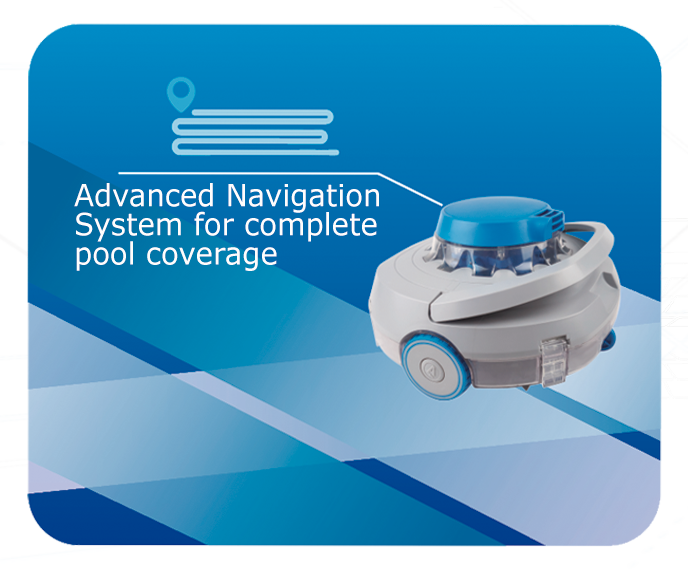
Smart Patterns that are Systematic (Grid Scan and Gyroscopic) These patterns make sure the robot covers the whole pool surface as efficiently as possible. This means that the system for filtration is able to keep it clean.
10. The relationship between robots and primary pool filtering.
A robotic cleaner can be described as an auxiliary cleaner. It is able to clean the pool's surfaces (floors walls, walls and the waterline) before transferring the debris into its self-contained container or bag. It also reduces the burden on your pool's main pump and the filter system. The primary filter still filters particles that are dissolved, as well as it circulates chemicals. Robots cannot take away the need for your main filtration system to run daily and works with it to provide healthy and clear water. Follow the recommended consejos para limpiar la piscina for more examples including swimming pool issues, robot for the pool, swimming pool robot cleaner, swimming pool for swimming, swimming pool cleaning services near me, in the swimming pool, pool sweeper robot, pool s, swimming pool cleaners near me, robotic cleaners for above ground pools and more.
Top 10 Tips On How To Get The Most Out Of Your Robotic Pool Cleaners With Regards To Power And Energy Efficiency.
The efficiency of energy and power sources of robot cleaners are crucial to consider when choosing one. They will have a direct impact on the operating costs of your equipment in the long run, as well as their impact on the environment. Robotic cleaners don't rely on the pump in the pool which is an enormous energy consuming. They are powered with their own motor which is low voltage and extremely efficient. The most significant benefit of these machines is that they help save enormous amounts of energy. Not all robots work in the same way. You can select a robot by analyzing the power consumption, modes of operation, as well as the required infrastructure.
1. Independent Low Voltage Operation The main benefit.
This is the basic idea. A robotic cleaner has its own pump and motor that are powered by a plug-in transformer. It operates using low voltage DC energy (e.g. 32V 24V, 32V) that is more effective and safe than running the 1.5 to 2 HP main pump for hours at a time. This allows the robot to run without running the main pump.
2. Calculating the savings: Watts vs. Horsepower.
It is essential to comprehend the savings you could make. A typical pool's pump uses between 1,500 to 2,500 Watts per hour. A robotic system for pool cleaning that is of top quality however will consume between $150 and $300 watts each hour. This is a reduction in energy of around 90 percent. The energy used to run a robotic device on a 3-hour cycle is roughly equivalent to running several lights in a home at the same time. This is in contrast to the main pump which consumes energy similar to an appliance.
3. The DC Power Supply/Transformer and its Critical Role
The black box you see between your cable and your plug of your robot isn't just a power cable. It's an intelligent Transformer. It transforms 110/120V AC into DC power for the robot. It is essential to ensure that the part is of high quality to ensure the safety and performance. The circuitry is also used to control the programming process and offers Ground Fault Circuit Interruption protection (GFCI), which cuts the power immediately when there is an electrical problem detected.
4. Smart Programming to Improve Efficiency.
Programming directly affects the energy consumption of the robot. The capability to choose particular cleaning cycles is a useful feature.
Quick Clean/Floor Only Mode This mode allows the robot to run for a shorter duration (e.g., 1 hour) and will only be able to activate the floor-cleaning algorithm using less energy than a full-cycle.
Full Clean Mode: A standard 2.5 to 3 hours cycle for a thorough cleaning.
To reduce the amount of energy wasted, you should limit your use to the power that is needed to complete the task.
5. The Impact of Navigation on Energy Consumption.
The energy consumption of the robot is directly connected to the path it takes when cleaning. It can take up to 4 hours for a robot that uses random "bump and turn" navigation to cleanse a pool. This is not efficient, as it consumes more energy. A robot with systematic, gyroscopically-guided navigation cleans the pool in a methodical grid pattern, completing the job in a shorter, predictable timeframe (e.g., 2.5 hours), thereby using less total energy.
6. GFCI Outlet Requirement & Location.
To make sure that the robot is safe, it must be plugged in to an Ground Fault Circuit Interrupter outlet (GFCI). These outlets have "Test" and "Reset" buttons that are commonly located in kitchens and bathrooms. If your pool is not equipped with a GFCI outlet, one should be set up by an electrician who is licensed prior to using the cleaner. The transformer needs to be at least ten feet from the edge of the pool to protect it from water splashes and the elements.
7. The length of the cable, its voltage drop and Cable Length
In very long distances "voltage loss" occurs in low-voltage cable. Manufacturers have a limitation on the length of the cable (usually 50-60 feet). A cable that is too long could decrease the power that is available to the robot. This could cause a decrease in performance as well as slower movements and a reduced ability to climb. Check that the cable on the robot is sufficiently long to allow it to travel to the furthest point of your pool from the outlet. However, do not utilize an extension cord because it can cause voltage drop, and cause an issue with safety.
8. Comparing the efficacy of other cleaners
Know what you're comparing the robot with.
They rely on the pump to supply suction. The pump needs to run for up to 8 hours every day. This can result in the cost of energy to be high.
Pressure-Side Cleaners: They use your main pump to create pressure. They usually include a booster pump which adds 1-1.5 HP of energy draw.
The robot's independence makes it the most cost-effective choice over the long run.
9. Calculating Operating Costs
It is possible to estimate the price for operating your robot. The formula to calculate costs is (Watts/1000 hours) + Electricity Cost ($/kWh)
Example: A 200-watt robotic device that runs for three hours, three times a week, at $0.15 for each unit of electricity.
(200W / 1000) = 0.2 kW. 0.2 9 hours/week equals 1.8 kWh. 1.8 kWh multiplied by $0.15 per week equals approximately $14 per annum.
10. Energy Efficiency As A Marker Of Quality
It is generally accepted that a product that is more efficient and has the latest motor technology will be of better quality. A robot that's capable of cleaning thoroughly in a shorter amount of time and with less power demonstrates better engineering, a better navigation system and an effective yet strong pump system. Efficiency isn't just about a high-wattage motor that has the capacity to climb or suction. It's about a combination of cleaning efficiency within a short cycle with low-wattage. A model that's efficient and properly designed will help you save cash on your energy bills for a long time. See the best productos para limpiar paredes de piscinas for website examples including robotic cleaners, waterline cleaning, swimming pool automatic vacuum, pool sweep cleaner, any pool, technology pool, robot to clean the pool, the pool cleaner pool sweep, pool cleaner pool, kreepy krauly pool cleaners and more.
